
Home
A Rambling Dictionary of Tallinn Street Names
Simon Hamilton (1954-still alive, apparently)
As its name suggests, the dictionary gives the meaning, origin, sometimes etymology, history and changing fortunes of Tallinn street names under diverse rulers – and Estonia has seen a lot, from the Danes and Teutonic Knights, through Swedes, Baltic Germans, Russians, to Nazis and Soviets… – as well as anecdotes, snippets of history and much trivia.
All author proceeds go to Tallinn Children’s Hospital Foundation (Tallinna Lastehaigla Toetusfond) so just buy and give it away, you must have a cantankerous old relative to annoy somewhere ;o)
For the cover, we have gone for the lexicologically logical.
The book should have been published a few years ago, but “complications” arose. The website content is essentiallly finished and now looking for a publisher (suggestions, recommendations, testimonials, etc., all welcome! Watch this space.
Tarabella (0)
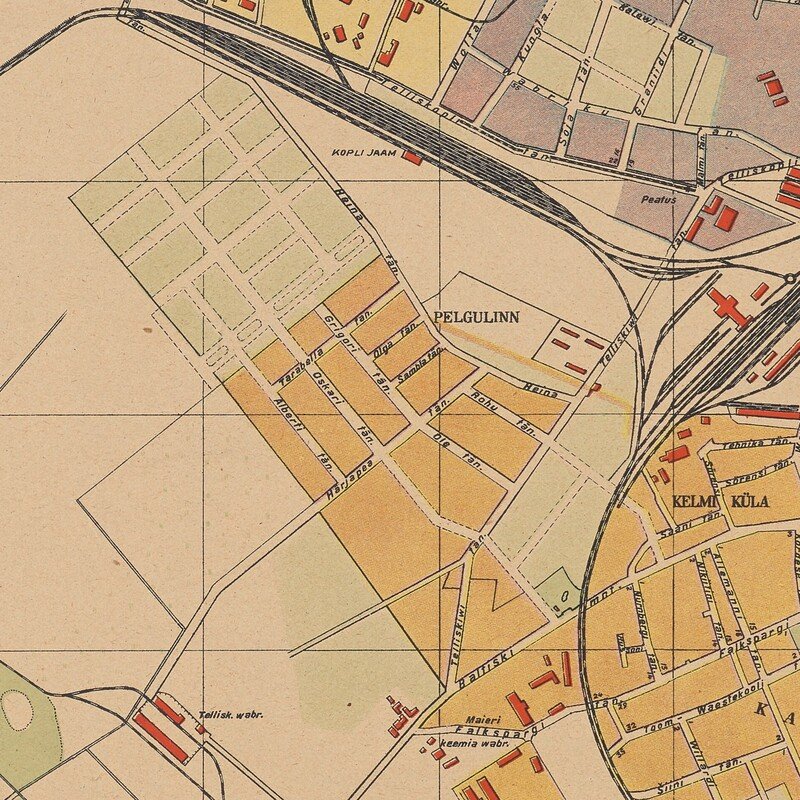
Not the obscure mythological deity it has been assumed to represent, but the name of city councillor and arbitrageur Albert Koba’s dog. Born 1878, Koba was also a busy real-estate developer, creating and naming streets in Lilleküla (see Endla), Pelgulinn (this one, see below) and Sikupilli (Asunduse), many named after the more bipedal members of his family. Despite the rumours, there seem to be only five (maybe six) ‘Kobaesque’ street names attributed to him in all: the present one, renamed Timuti in 1939; his own: Alberti, now Roo; Olga, his blameless better half (divorced 1927), now Pebre (another Olga once existed, now Vainu, but perhaps a bit far from his usual haunts); Oskari, now Ristiku, and Grigori, now Õie, both after after local alderman Oskar Gregory (friend? business partner? in-law? bear or seal?...). Another street, poss. the sixth, Sambla, now Nabra, named on the same date as Olga, can be seen on the 1922 map of Tallinn, but no information on this found so far. Koba’s name seems to have once been spelled Kooba, a word related to (from?) the Võro* (his parents were from Tartu) kooba, an outdoor, semi-underground cellar for storing potatoes. That’s growth.
* For spelling, see Kõivu.
Kõrgepea nukk (0)
High-head knoll. Not a street, a hill (or hilly area) some 60 m above sea level, one of the highest points in Tallinn, First mentioned in 1371 as a border marker of the city called variously Hohenhäubte (MHG) and hoghe houed or hoge höuet (MLG), translating as ‘high head’, the ‘u’ being understood as ‘v’, otherwise known as Kallapehe, meaning ‘bank-head’ or ‘on top of a klint escarpment’. See Lossi, The blue dot on the topographical map of Tallinn below marks the spot.
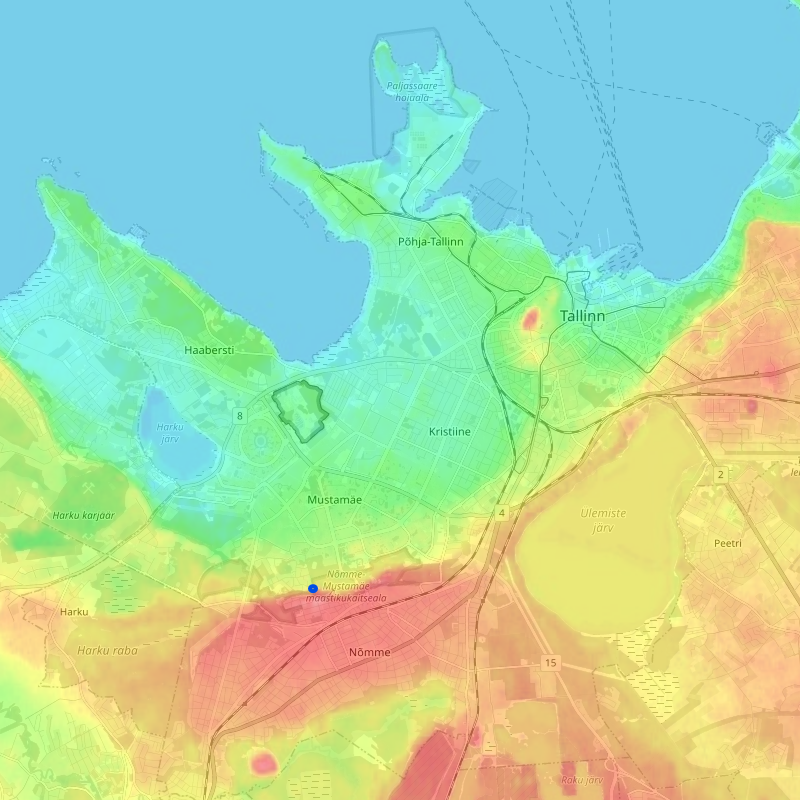
Detail of Tallinn elevations (blue dot indicates approximate location of Kõrgepea nukk) from topographic-map.com, see which for details.