
Home
Uus Slobodaa (0)
Not a street. No longer exists. So why? History. In the late 1820s, after the brief golden years of Vana Slobodaa, restoration work on the palace began again and a new sloboda (settlement, see Vana Slobodaa above) developed on the other side of Poska, roughly within the perimeter set by Narva, Vilmsi, Tobiase, Terase and Kreutzwaldi, with KNAB centering it at the corner of Kollane and Faehlmanni, At times, both Faehlmanni and Tobiase were given a Sloboda-based name. Known in Rus. as Новая Слобода (novaya sloboda) and sometimes referred to as Uus Agul, once (questionably in this case) meaning ‘new slum’, nowadays, ‘new neighborhood’.
Vana Slobodaa (0)
Not a street, but the historical name of a district whose outline is not 100% clear, the approximate contour being Roheline aas, spreading over time along the NE side of today’s Poska, from roughly Wiedemanni to Koidula and back. Historically, a слобода (sloboda, ±‘free settlement’, from Old Rus. свобо́да, svobóda, freedom) designated a settlement free of certain obligations, essentially taxes and levies, often to encourage colonisation. Over time, they became villages, communities, suburbs or even towns (see Balti Jaam), while its Estonian ‘equivalent’, agul, often tended, especially late 18th, early 19th C, to downgrade this to ‘slum’, which seems a bit harsh, but shanty-town or favela don’t really cut it either. In general, it seems to have just been a suburb for poor people or new arrivals to the city on the ‘other side of the track’. Be this as it may, the fact that it was called this could also suggest a touch of everyday racism for being largely inhabited by immigrant Russian laborers. Known – presumably later with respect to Uus Slobodaa – as Старая Слобода (Staraya Sloboda, Old Sloboda) and as Russisches Dorf (Russian village) or even Екатерининтальская Слобода (Yekaterintalskaja Sloboda), the settlement dates back to 1718-25 when Peter the Great (Peetri) decided to build what would become Kadriorg Palace (now art museum) for his consort, future Empress Catherine (Kadri). Requiring the employment and housing of thousands of workers: masons and carpenters, cooks and cleaners, as well as palace staff ranging from lackey to Castellan whose house, now the Eduard Vilde Museum, can still be seen. Peter died in 1725 and Catherine was not that interested and died herself two years later so the project sort of fell by the wayside. See also Tatari.
Vana-Tartu (Vana-Tartu)
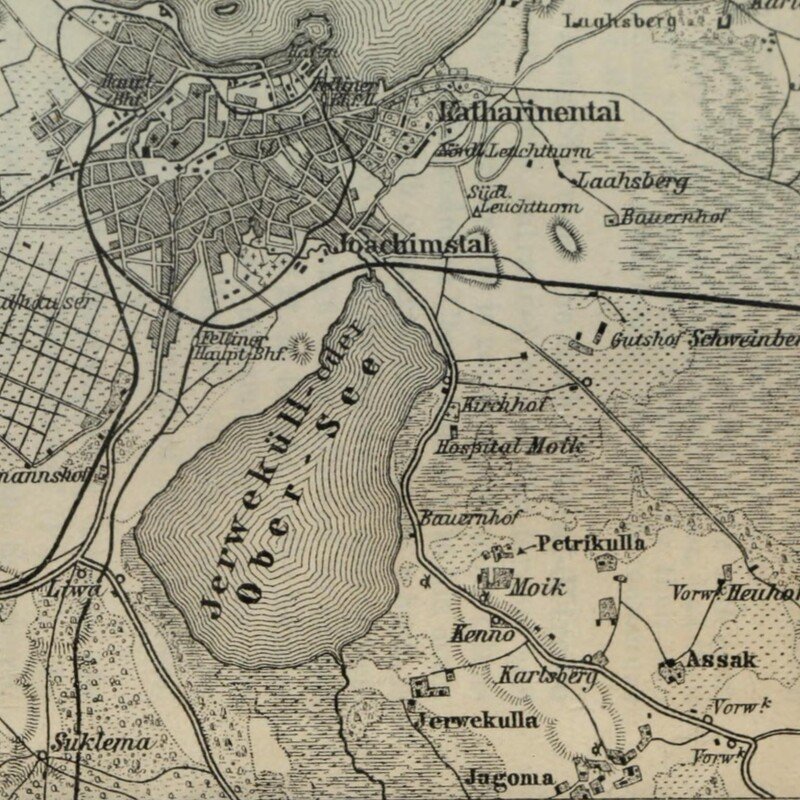
Road ‘splitting off’ today’s main Tartu maantee by the airport, following the shore of lake Ülemiste for a couple of kilometres then swinging back to join the main road again outside Tallinn. This was in fact the ‘old’ Tartu road, as seen on the 1914 Baedeker’s map below. Russian transliteration as Вана-Тарту Шоссе (Vana-Tartu chaussée, the latter from the French).
Vase (Vask)
Copper. One of a metals street group. See Hõbeda.