
Home
Juurdeveo (Juurdevedu)
Feeder line or railway, branch line. Street leads to Tallinn-Väike station. Many of Estonia’s domestic railway lines, e.g. Tallinn to Viljandi and Pärnu, used to be narrow-gauge (see Kitsarööpa). A feeder line connects passengers or goods to or from a main network, this one connecting the Tallinn-Väike narrow-gauge to the standard-gauge railway from Tallinn to St. Petersburg.
Hagudi (?)
One of the group of streets named for stations (well, platforms really) on the Tallinn-Türi Kitsarööpa line. Birthplace of Krusensterni. Street previously known as Феллинская ул / Fellin str. / Viljandi due to its location close to the old Felliner Hauptbahnhof or Viljandi Pea(vaksal) (Viljandi Main Station), today Tallinn-Väike. Felliner Bahnhof II was near Petrooleumi and the line ran (or probably ambled) down Vesivärava. As to the actual name, see, first, Hao. Given as Haggud in 1447, the name could come from the plural of the above hagu:hao > hagude (but why, why, why?... OK, maybe a local [and important] resource), but the -gud ending is redolent of Germanic Gut, property or possession. And it has been noted that the occasional Teuton did visit the area at the time… Other linguists have suggested Agu as a personal name and I’m not going to argue with that. See Rapla.
Karamelli (Karamell)
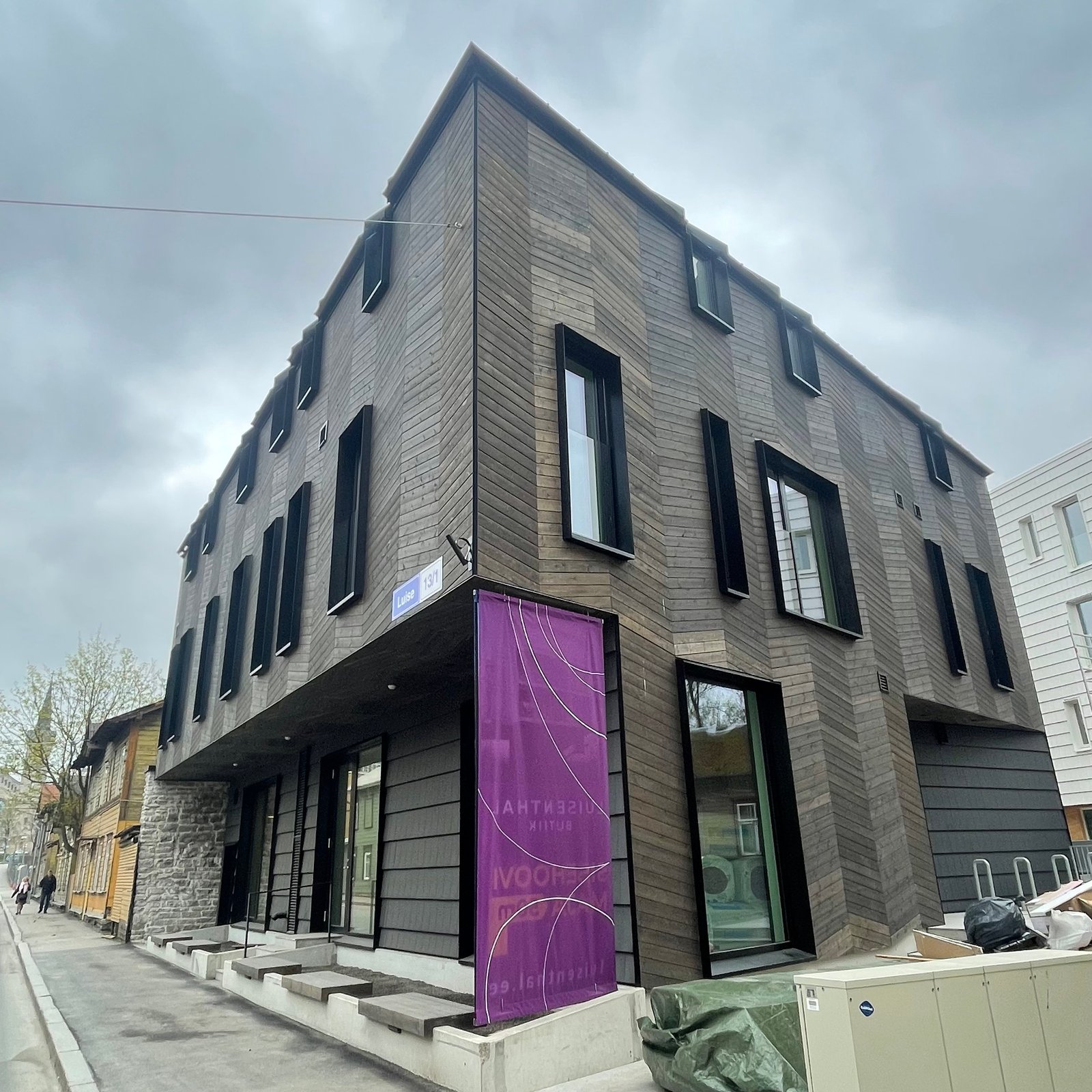
Caramel, after nearby sweeties factory. Named for the former Kalev chocolate factory nearby. Building in progress.
Hallivanamehe (Hallivanamees)
Lit. ‘grey old man’. Two possibilities paraphrased from from TT: 1) There used to be a very sharp curve here resulting in numerous accidents. Given the, ahem, abstemious nature of Estonian drivers, any accident had to be because of Ülemiste Vanake leaping into the middle of the road (then again the old man of Ülemiste lake was a liquid spirit); 2) After the curve, then street, where a grey-bearded old codger used to live until his house was demolished. In my first edition, I followed this by another ‘possibility’: confusion with a similar word that did exist: hallivatimees, either a wolf, grey or otherwise, or another similarly grey animal, bird or insect, as well as, in typically military fashion, a ‘grey-coat’ or soldier. Other explanations link its animal form to kriimsilm (scar-eye), a wolf of Estonian folklore, where kriim suggests something soiled, scratched, wounded, maculated and malevolent. I suspected Hallivanimees to be a sanitized version, one easier to pronounce. Either way, by the 80s, Hunt Kriimsilm had turned into a cheery little TV puppet of a proletarian wolf with a red check cloth cap and tie, and an annoying tendency to sing. So perhaps it was another scary name from Estonian folklore? You already have Pakase, Pikri, Pikse, Tuuslari, Uku, Vilisuu… The street was named on 1958-02-14 along with 80 or so others, quite a bunch, so maybe a typo? But none of these three explanations passes the test of ‘why’. There is no curve in the road, other than the minor one created to build it. There’s essentially no mention of any Hallivanamees before this date and, to be honest, it just feels wrong. Then came the “Aha! moment” when I visited the street in question, home today to ARS Kunstilinnak, descendent of Kunstitoodete Kombinaat (Art Products Combine), which is, I suspect, the key. In the 50s, Estonia was undergoing a revival in ceramics, producing work so good the Soviet Union was showing it off wherever they could. By ’58, the then ARS had some 700 people employed there, with probably a hundred or so working in ceramics. The main occupational hazard of pottery is lung disease such as bronchitis, asthma and silicosis due to dust, and if there’s dust in the lungs there’s dust on the floor, on work surfaces, on pretty much everything, including clothes, faces, beards and hair. I don’t know whether the plant had showers or not, but even if they did, recollecting my own early days as shot-blaster, I’m sure that many would just go straight home and maybe get cleaned up later. And this is how the name came into being: the ‘grey old men’ were probably employees at the ceramics workshop and Hallivanamehed a nickname given them by the relatively cleaner Kalev chocolate factory workers in the Kohila plant on the other side of Pärnu mnt.