Names
Ahju (Ahi)
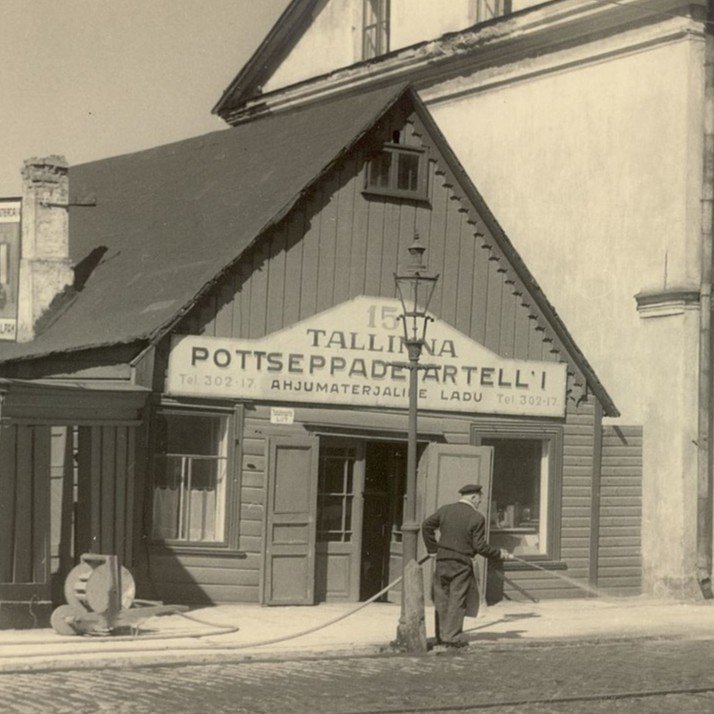
Stove, oven, kiln. For those interested in trivia: one of the two >3‑letter street names whose letters are in alphabetical order (see Hiiu). Started life simply enough in German as Töpfergasse (1882), potter’s street, apparently after a local craftsman called Floss, then Estonia stepped in with only four of its six main possible spelling permutations – Pottisseppa, Pottiseppa, Pottisepa and Potissepa (all 1885) missing out not only the most sensible, Potisepa, but also the most accurate, Pottsepa, and why compound words involving sepp (smith) do not usually involve a genitive in the first place I don’t know (see Kullassepa, Rätsepa & Sepa*) – then the Russians either translating it nearly correctly as Гончарный пер. (1892, pottery lane, пер. = abbreviation of переу́лок) or incorrectly as Печная ул., Kiln (prob.) street (1884). Either way, given the humungous alternative of An der alten Wasserleitung (1881) or am Stadt-Wassercanal (1882) from the water supply prolonging that of Veerenni, a four-letter word was probably in order, and an anagram of Jahu it became.
* Although perhaps they do, see Nõmme.
Ahtri (Ahter)
1) Stern, poop; 2) By extension (no pun intended): buttocks, (often) ladies’, (usually) generous. Term borrowed from Low Saxon and Swedish seafarers, and related to ‘aft’ and ‘after’, as well as ‘off’ and ‘ebb’. Known until 1958 as Simeoni, Siimeoni, Siimoni or Simuna after its Saints Simon and Anna orthodox church (built 1752-1871), now known as Püha Siimeoni ja naisprohvet Hanna kirik (Saint Simeon’s and Prophetess Anna’s church (see Paadi). Part of the E67 from Helsinki to Prague, see also Reidi.