
Names
Aedvilja (Aedvili)
Vegetables, greens, after a large market garden nearby in the 19th C or earlier. Formerly recorded as Aiavilja (same thing?) (1908-1938) and Galkini (1870-1882) after Mikhail Nikolaiyevich Galkin-Vraskoy 1834-1916 (Михаил Николаевич Галкин-Враской), head of the Governorate of Estonia from 1868-70. Temporarily known by the bilingual Estonian-Russian concoction of Põik uulits (±cross-street road, 1885), but the eat-your-veggies connection kicked back in in 1882 with Gemüsestraße and Овощная ул., the translations of which I’m sure you understand.
Aegna (Aegna)
Claiming to be an avenue (puiestee) but more of a footpath running NNE-SSW through Priisle park from Läänemere to Linnamäe. For more details, see Aegna asum.
Aegna asum (Aegna) 
Island and Sub-district off the coast of Tallinn. Known as Wulf or Wulfö to the Germans, Аэгна or Вульфъ to the Russians (transliterating into Aegna or Vulf, see note on Russian spelling in intro), and Ulffö (unusual with two f’s) to the Swedes. Thus known as far back as 13th C: Wolvesöö (1348), Wolffz Öön (1698), Wulli saar (1724), etc., but mutating to Eikisari (1683) with corresponding switch from wolf to horse, eik being a dialect Swedish (western coastal Estonian) word for horse, cognate with and probably derived from Latin equus, and how it got from one to the other is curious to say the least... Perhaps influenced by other coastal mainland Swedish and Finnish Swedish dialects where the word ranged through heik, ek, ök and ög to öj, could there have been a mishearing / misunderstanding with Swedish ö, island, due to various indigenous and migrant speakers pronouncing it differently? Or simply preferring the more welcoming appellation of horse over wolf? Either way, the name took off, thru Äigna (17th C) Agnasaar (1724) and thence to its present name. Aegna is considered part of Tallinn, but be careful when crossing the road. Part of an Estonian island group, see Kihnu. See also Aegna.
Ahju (Ahi)
Stove, oven, kiln. For those interested in trivia: one of the two >3‑letter street names whose letters are in alphabetical order (see Hiiu). Started life simply enough in German as Töpfergasse (1882), potter’s street, apparently after a local craftsman called Floss, then Estonia stepped in with only four of its six main possible spelling permutations – Pottisseppa, Pottiseppa, Pottisepa and Potissepa (all 1885) missing out not only the most sensible, Potisepa, but also the most accurate, Pottsepa, and why compound words involving sepp (smith) do not usually involve a genitive in the first place I don’t know (see Kullassepa, Rätsepa & Sepa*) – then the Russians either translating it lazily as Гончарный пер. (Goncharnyy per., pottery lane, пер. i.e. переу́лок, pereúlok, in 1892) or as Печная ул., (Pechnaya: stove, oven, kiln…, 1884). Interestingly, the apparent shift from stove to potter is because an Est. pottsepp was not always a potter but often a stove, oven and heating-system maker or repair guy. Either way, given the humungous alternative of An der alten Wasserleitung (1881) or am Stadt-Wassercanal (1882) from the water supply prolonging that of Veerenni, a four-letter word was probably in order, and an anagram of Jahu it became.
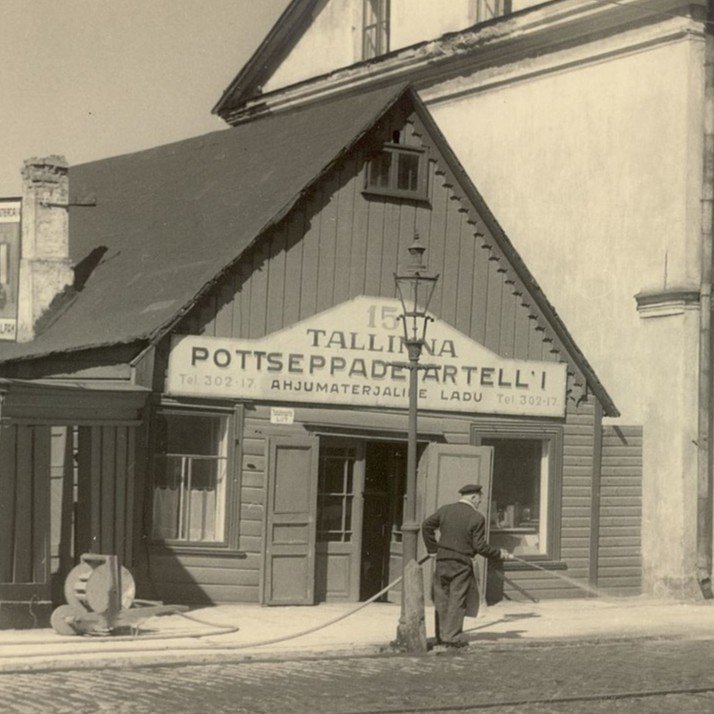
* Although perhaps they do, see Nõmme.
Ahtri (Ahter)
1) Stern, poop; 2) By extension (no pun intended): buttocks, (often) ladies’, (usually) generous. Term borrowed from Low Saxon and Swedish seafarers, and related to ‘aft’ and ‘after’, as well as ‘off’ and ‘ebb’. Known until 1958 as Simeoni, Siimeoni, Siimoni or Simuna after its Saints Simon and Anna orthodox church (built 1752-1871), now known as Püha Siimeoni ja naisprohvet Hanna kirik (Saint Simeon’s and Prophetess Anna’s church (see Paadi). Part of the E67 from Helsinki to Prague, see also Reidi.