
Home
Viki (Vikk)
1) Common vetch; 2) limestone paste; 3) bung, spigot; 4) All that for nothing, ‘street’ no longer exists... Anagram of Kivi. Nevertheless, the English term ‘vetch’ cannot but instantly remind one of the genial Peter Simon Pallas (1741-1811), scientist, geographer, and explorer, one of the precursor thinkers of Darwin’s theory of evolution and discoverer of numerous plant and animal (the cat, obviously) species, not to mention Ammodytes hexapterus, the sand eel, väike tobias (‘little Toby’, but see Nigli), which he mistook for a mollusk (we may forgive him) and, I’m getting there, the vetch Astragalus alopecurus. Odd, this is not a street. For some, perhaps an abbreviation for the so-called Vikimõisa ‘Ward’, for others, an underhand addition to a paper map designed to trap plagiarists.
NB: If anyone can help me get my greasy hands on Pallas’ multilingual dictionary I would be exceedingly grateful to the extent of rewarding said person with cash and/or a pint, whichever you can afford to buy me ;o)
Roheline aas (0)
Green meadow. ‘Green’ comes in three species, along with Roheline turg and Roheline tänav (warning! in Estonian alphabetical order, see Intro). Called Grüne Wiese or Grüner Platz (meadow & square, respectively) in the 19th C, it was also known as Екатеринентальский луг (Catherine’s meadow) at the same time, probably after Catherine I of Russia, see Katariina.
Roheline tänav (0)
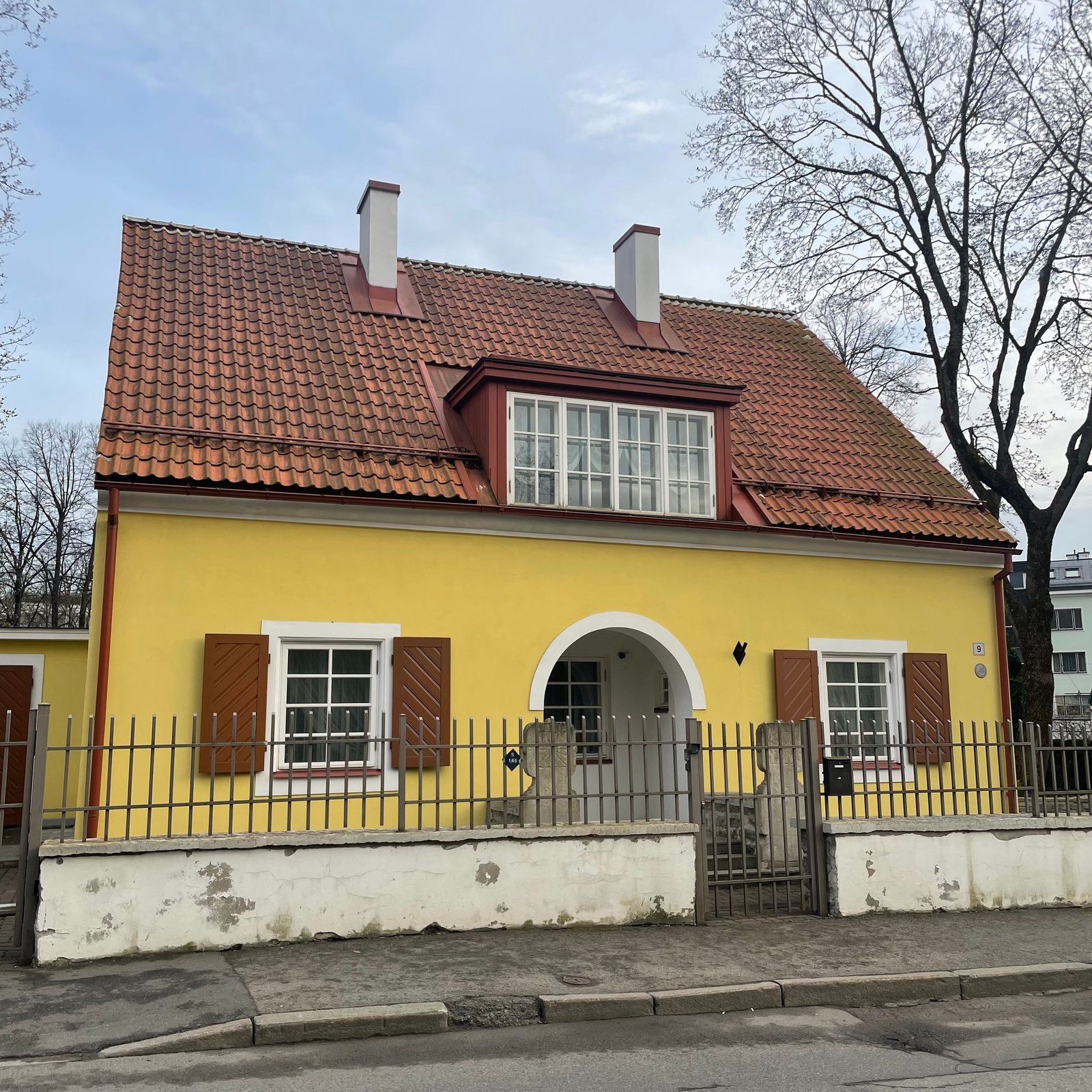
Green street. ‘Green’ comes in three species, along with Roheline aas, and Roheline turg This one, a quiet street in the quiet suburb of Nõmme. But see also Valge.
Roheline turg (0)
Green market. ‘Green’ comes in three species, this one, plus Roheline aas and Roheline tänav. Translated into Russian verbatim as Зелёный рынок (Zelonyy rynok). Despite its designation, this one, named in 1989, has space for 2 stalls, 1 tax inspector and half a low-cal cauliflower.