
Home
Kitzbergi A.
(August Kitzberg, 1855-1927)
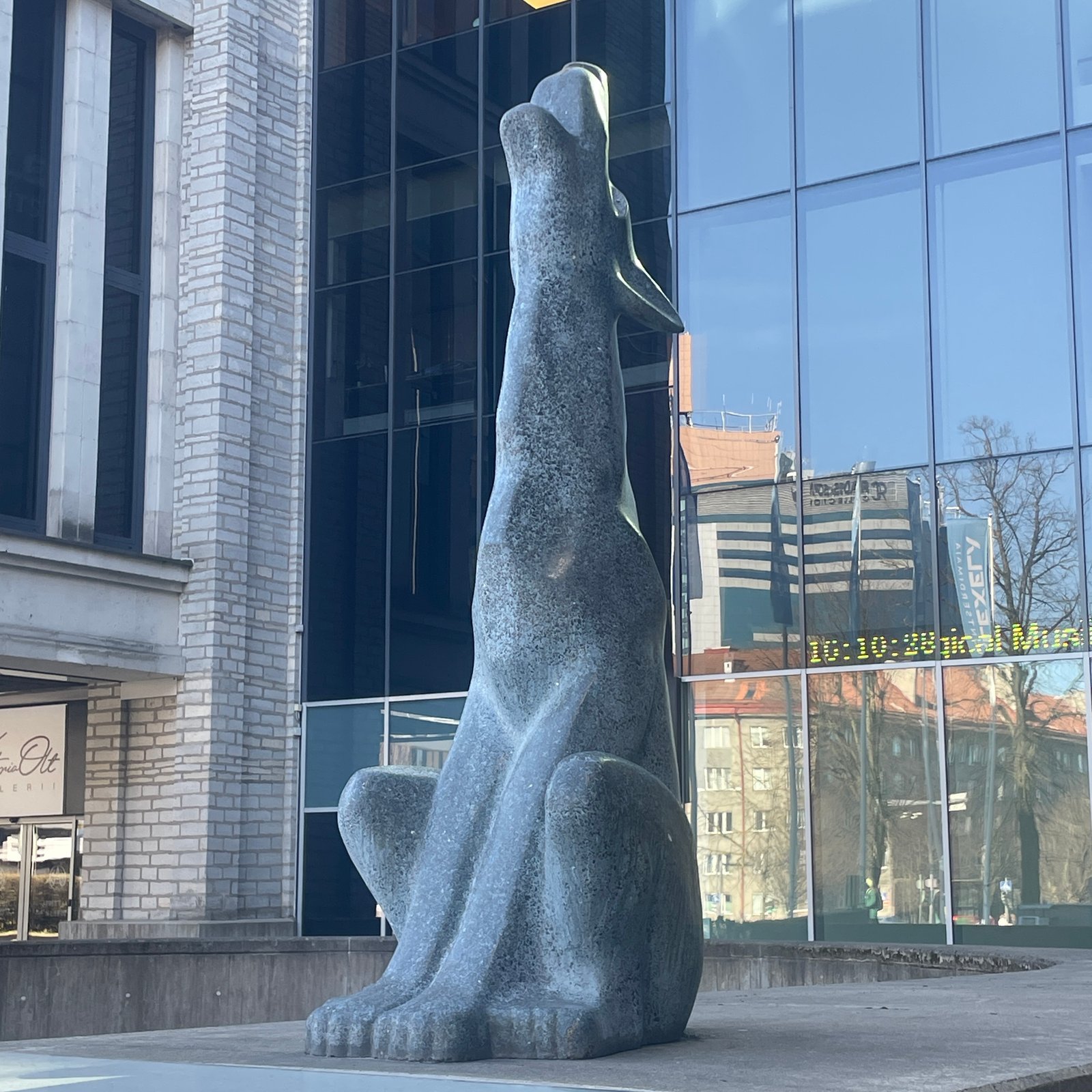
Author and playwright. Romantic to realist writer of short stories and, by which he’s better known, plays such as Libahunt (Werewolf. Liba looks suspiciously like a modification of libe, meaning slippery, slick, unreliable, etc., with negative connotations: e.g. libedad sõnad translates to weasel words; and mysogynist cognates: lita, libu, lits, bitch, prostitute, slut, etc. Not surprisingly, werewolves in Estonian folklore tended to be women (while English werewolf is from old English wer [man, male person, from PIE *wi-ro-, man] + wulf, but see Viru tänav), and Kauka jumal (God/Lord of the Purse [but see Börsi]). Knowing Kitzberg to be a committed anti-drinker, playwright Oskar Luts (see Kevade) kept a bottle of whisky in a sculpture of his head. In 2005, the post office gave him a sesquicentennial first-day cover. Kitzberg lived at Posti 23, Viljandi, in 1893-1894, so they probably owed him one.
Kivikülvi (Kivikülv)
Blockfield, aka felsenmeer, boulder field or stone field. An area of land or sea covered by boulders or large rocks, thought to be the result of frost weathering. True to form, Veskimetsa kivikülv is about 600 m NW at ///cobble.status.hope. For other erratic-themed locations, see Kivila.
Kivi (Kivi)
Stone, rock, boulder. Judging by the large number of cognates (among other things) – kivi (Finnish, Karelian, Izhorian, Olonets, Ludian & Veps), tšivi (Votic, for stone, flint, millstone...), ki’v (and variants, Livonian), кӱ (Mari), кев (Eryza & Moksha), ke, kew & kaw, (millstone, in Udmurt, Ostyak & Vogul respectively), kő, more apparent in the accusative case: kővet (Hungarian), and geađgi (Northern Sámi), then, stepping on thinner ice, kevi (Hunnic) and, even further back, kuikna (Etruscan: stone projectile) and Sumerian*[1] kur, ku‑ur or ku – one of the oldest known words common to Finno-Ugric languages. Interestingly, various FU creation myths tell of a creation egg, cracking open by various agencies, releasing the sun, the moon and a rock. Personally, rocks have only a limited capacity to excite my imagination, but imagine a people coming to apprehend the huge boulders left by the retreat of the ice (see Rändrahnu). How did they get there?... There must have been much mystery there. Part of what I call the kivinimeliste tänavate hulk (stone-named street cohort). Tartar, for those who’re interested (or don’t brush regularly), is called hambakivi (toothstone), probably copying from German Zahnstein. No relation to Tatari. Anagram of Viki. For other erratic-themed locations, see Kivikülvi.
* The Etruscan and Sumerian etymologies are essentially from Prof. Dr. Alfréd Tóth’s various mold-breaking dictionaries, the validity of which I am unable to judge. Bear in mind, however, that Sumerian, as far as is known, is a language isolate, like Basque. In other words, no other language has been found to be even remotely related to it (other than by the entertainingly lunatic Edo Nyland and his “Basque-Saharan” theory). Even so, as a former lingua franca, it undoubtedly loaned out many words to other languages. To give a rather simplistic parallel, although Estonian and Hebrew share essentially zero DNA, Estonian can borrow יען and bend it into jaana (ostrich). Likewise, the fact that Estonian lava can mean hotbed (among other things) has nothing to do with English volcanoes. While not impossible, and intriguing, there does not seem to be any compelling evidence for Estonian roots in Etruscan.
Kivila (Kivila)
Lit. Place of the stone. Although kivila could be a contraction of kiviküla (stone village, see Hiiela for -la ending), which used to be a slightly pejorative or mocking way of saying ‘town’, reflecting the grim grey gracelessness of the Soviet-built Lasnamäe housing estates, it’s probably not, simply indicating proximity to the Mustakivi erratic boulder. Based on the above reasoning, it could also come from, e.g., kivivälja or similar, simply designating the place you to go to dig up rock, Lasnamäe is, after all, on a limestone plateau, and numerous quarries operated there in the Middle Ages, supplying Tallinn with much of its building material. For other erratic boulders or erratic-themed locations, see Rändrahnu and Kurikneeme.