
Home
Estonia (Estonia)
Named in 1923 after the Estonia theater and concert hall, built 1911-13. According to TT, known previously as Peters-Promenade (Peter’s Promenade), Vene turu promenaad (Russian-Market Promenade, but see Viru väljak), Promenaad (Promenade), Der Ring/Ringstraße (Ring Road, or part of it, along with Mere puiestee and others but don’t ask which), Gogoli puiestee (Gogol avenue), Karjavärava puiestee (Cattle gate avenue), Vabaduse puiestee (Freedom avenue), Viruvärava puiestee (Viru gate avenue), and perhaps many, many others. No.11 was the Estonian Red Card HQ. After two of them, non‑Communist footballers would be sent off to Siberia.
Ahju (Ahi)
Stove, oven, kiln. For those interested in trivia: one of the two >3‑letter street names whose letters are in alphabetical order (see Hiiu). Started life simply enough in German as Töpfergasse (1882), potter’s street, apparently after a local craftsman called Floss, then Estonia stepped in with only four of its six main possible spelling permutations – Pottisseppa, Pottiseppa, Pottisepa and Potissepa (all 1885) missing out not only the most sensible, Potisepa, but also the most accurate, Pottsepa, and why compound words involving sepp (smith) do not usually involve a genitive in the first place I don’t know (see Kullassepa, Rätsepa & Sepa*) – then the Russians either translating it lazily as Гончарный пер. (Goncharnyy per., pottery lane, пер. i.e. переу́лок, pereúlok, in 1892) or as Печная ул., (Pechnaya: stove, oven, kiln…, 1884). Interestingly, the apparent shift from stove to potter is because an Est. pottsepp was not always a potter but often a stove, oven and heating-system maker or repair guy. Either way, given the humungous alternative of An der alten Wasserleitung (1881) or am Stadt-Wassercanal (1882) from the water supply prolonging that of Veerenni, a four-letter word was probably in order, and an anagram of Jahu it became.
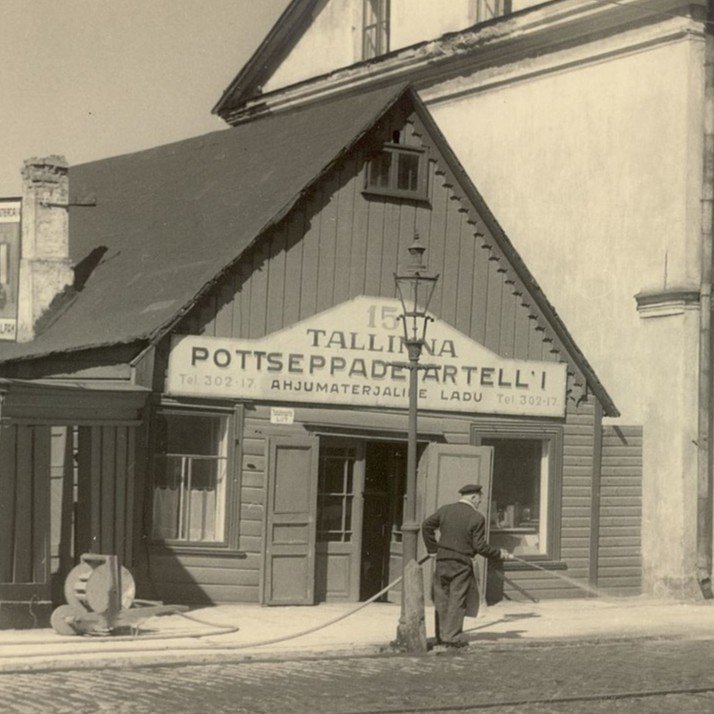
* Although perhaps they do, see Nõmme.
Kentmanni
(Wilhelm Gottfried Kentmann, ca.1800-ca.1874)
Pedagogue and headmaster of a charity school for poor children (Luthers Armenschule, funded by Christian Luther) from 1830-1874 (attended, among others, by Bornhöhe E. and Vilde E.). The street was also named for short periods (1939-1940 & 1941-1944) after Konstantin Päts (trivia drop: päts, or loaf of (corn)bread, is a possible cognate of Georgian ფეჩი, peči or ‘cast-iron stove’ and the street is 350 m from Ahju), 1st President of the Republic of Estonia (died 1956 at a Soviet psychiatric hospital while undergoing a rest for the insanity of believing he actually was President of the Republic of Estonia), interspersed by Kreuksi J. in the Soviet occupation (1940-1941 & 1944-1989) and, seemingly but uncertainly, a brief, few-day interlude in 1942 after Hermann Göring. Street namesake often confused Kentmann senior and junior, the latter, Woldemar Friedrich, was author of Koolilaste Geograahwia raamat (Geography book for schoolchildren, 1875) and Geograahwia kaardid koolilaste geograahwia-raamatu lisaks (Maps for a geography textbook, 1884).