
Names
Ogaliku (Ogalik)
Stickleback. Despite the importance of sticklebacks to the development of ethology, the street this name was given to in 1995 was gutted six years later. Then, adding insult to injury, they gave it to another street and, less than 12 weeks later, binned it again! What have they got against sticklebacks? They don’t even have Raudkiisk (cf. Kiisa), the sea stickleback or, is it’s known in Ireland, 15-spined stickleback, only true marine Gasterostid, so lovingly linnaeanized as Spinachia spinachia (raud = iron > spinach, Popeye...). All wrong of course: spinach, originally ‘Spanish vegetable’, actually contains less available iron than cauliflower. The story has it that, way back in the 1870s, a certain German Dr. E von Wolf published a paper giving spinach’s iron content as 10 times higher than it was due to a misplaced decimal point. Maybe, but the certain German Doktor has proved remarkably elusive and the whole thing may well be an urban legend, perhaps cooked up to exculpate the Sailor Man’s creators for their blathering nonsense. Either way, a tricky piece of greenery. As the decidedly odd US lawyer Clarence Darrow once said: “I don’t like spinach, and I’m glad I don’t, because if I liked it I’d eat it, and I just hate it”. The stickleback (or tittlebat as Pickwick would call the three-spined variety) is a noble fish, a close relative to the sea-horse and scaleless as a dolphin, it is a nest-builder and tender wetnurse of relatively cuddly sticklebabies cynically abandoned by an uncaring mother. See Maimu.
Õhtu (Õhtu)
Evening. Leads to Hommiku.
Õie (Õis)
Flower, blossom. Known as Datši, Datschi, Datschenstraße, Villenstraße (villa) and/or Дачная ул. (dacha). The Russian dacha could take on various forms, ranging from ‘country seat’ (see Charlottentali) to cottage, referring initially to land or estates given (дача, something given, from дать, to give) to nobles by the Tsar starting in the 17th C]) until 1922 (see Köleri J.). And name changed to Tõdva from 1940-1941, presumably after the eponymous river (aka Vääna, Tedva, Hüüru, Topi and Saku), village and historical bridge in nearby Saku.
Õilme (Õile)
Flower, blossom. Street originally called Õie, possibly a Virumaa dialect or other form of this. Interestingly, this is one of those rare words that usually only exist in the plural, perhaps representing the figurative blossom. In the singular, it’s also a dated woman’s name, almost extinct by the fifties, and rare in Tallinn anyway, more of a country name, so the two neighboring streets named after women’s names, Tiiu and Pille, may be due to assuming Õilme was the woman’s name and not the blossom as an irregular singular. The streetname commission likes groups. Anagram of Lõime.
Õismäe (Õismägi) 
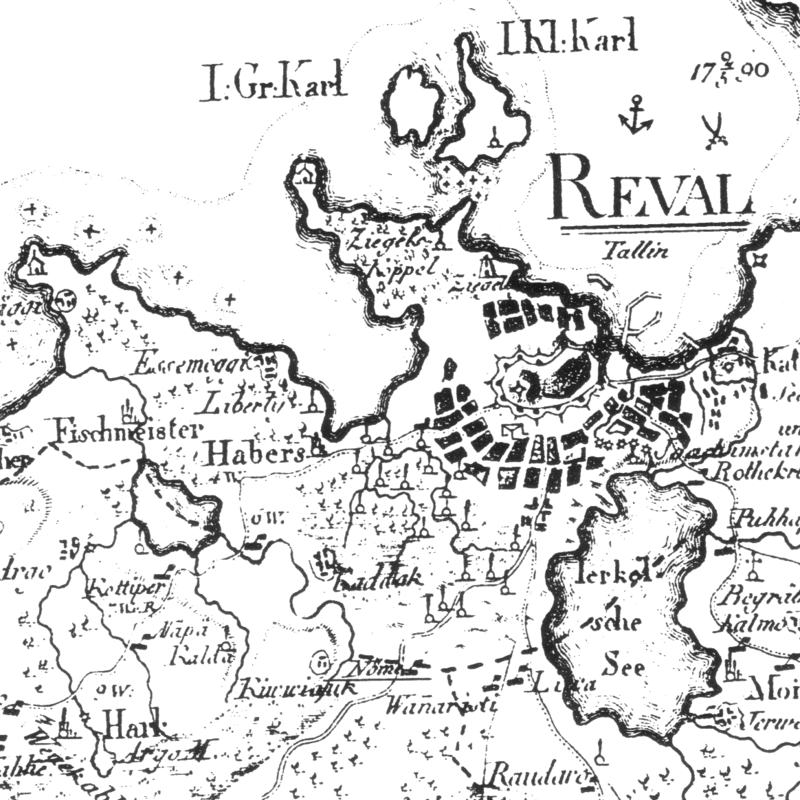
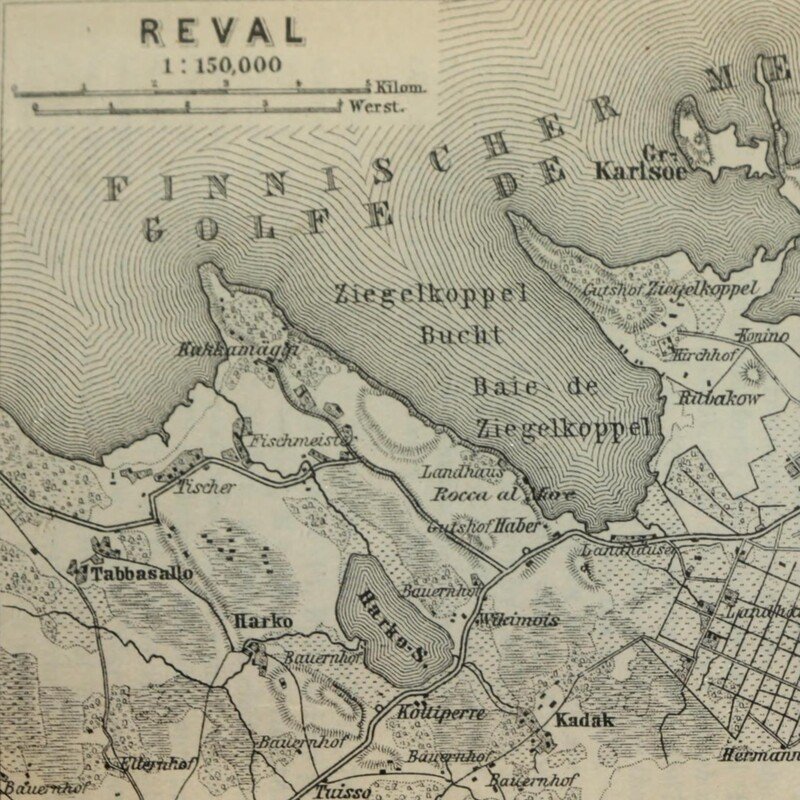
Lit. Flower/Blossom hill. After a historic Haabersti estate, and probably nothing to do with flowers at all… First recorded as Heuschlag Heise Nehm, it looks odd. Starting at the beginning: Heuschlag is an outdated word (even my Haensch-Haberkamp – translator brag – doesn’t have it). Literally a hay-strike, its closest companion in meaning is Old Eng. ‘mede’, giving Eng. ‘meadow’. This conflicts with certain 19th-C maps indicating the same land as either Heuschlag or Weide (pasture). But since Waxelberg’s 1688 map indicates the former with owners’ names and pasture was often common land, we can go with ‘meadow’. Heise is trickier. It could refer to a person: DEPn hints at Heysze Pattiner, mayor of Tallinn in 1516, but it could refer to any other person of that name. It also means the handle or ‘ear’ of a vessel or container, and if MLG Nehm is equivalent to Est. Neem (see Neeme), it could refer to a particular-shaped headland. Could. Kivi was the first to associate Õismäe with Heuschlag Heise Nehm given in the Landtbuch der Stadt Reval (Tallinn land registry), as does DEPn, possibly (or in part) due to its name foreshadowing its later Eismeggi and Eisneme. The Landtbuch does not seem to have an entry for the date usually quoted, 1646, but it does for 1631, and this is where it gets interesting. The entry in question concerns the rightful usage of meadows and the Heuschlag Heise Nehm is associated with the ‘Siechen- und Laddienpehische Heuschlege’ (invalids’ and Laddienpe meadows, see Lahepea). Siechen, from siech (ailing) is often associated with and translated as leprosy (see Jaani seek) which, back then, it may well have been. Leprosy, however, was often confused with tuberculosis, TB, better known as scrofula, the ‘king’s evil’. One Est. term for leprosy was pidalitõbi (from pidali, spital, short for Hospidali; and tõbi, disease or evil, suggesting a long-term ‘in-patient’ disease, cf. Finnish dialect topi for lung disease); while its Ger. equivalent, Aussatz, derives from its more literal meaning of outcast, i.e. shunned or being a pariah. So it could be either. Heise, on the other hand, notwithstanding the interpretations given above, could also mean hoarse or even unclean, and while the former may not be a common symptom of TB in itself, coughing is. The data are sparse and inconclusive but it is not unreasonable to suggest that the derivation of Õismäe from Heise Nehm (Unclean Point) and its income-generating meadow(s) could come from a refuge or leprosarium on a hill by the sea far from the city. The hill on Baedeker’s map (below) looks like the idea place. As usual, I could be totally wrong, so corrections and comments welcome. Once known as Eismeggi (1697), Essemäggi (1798, see map below), Ейснеме (Eisneme, 1808), Eisneme & Gesinde Eismäggi (1868; Gesinde means either ‘dependents’, any of a noble’s entourage, from companions to farm-hands and servants, or ‘dependency’, a property run by the same, so probably a kõrvalmõis, see Mõisa). See also Mäe for discussion.
Õitse (Õitse)
Inflorescence.