
Names
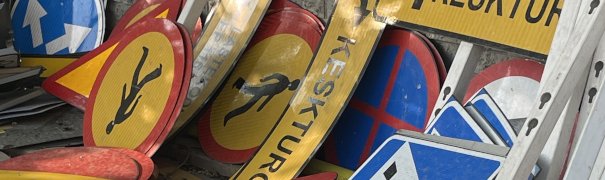
Keskuse (Keskus)
Center. It being the street planned to be the center of the then new Mustamäe district. But, given the naming of Viru Keskus, Kristiine Keskus, Järve Keskus and so on, also ‘mall’.
Kessi (Kess)
Net bag (bag for putting nets in), backpack, pouch, wallet or basket made from birch bark or bast, cf. Hungarian kász-u, ‘a little container or pot made of bark’; both suggested as possibly related to Etruscan cesu, piece, trunk. Part of a fishing-tackle group, see also Käba. Not to be confused with Kessu, eponymous partner in Robert Vaidlo’s children’s novel and later television series, Kessu ja Tripp (ja = and). Named at the same time (2003) as Kassi when which went where was a bit of a toss-up.
Ketraja (Ketraja)
Spinner, after those working at Balti Manufaktuur (see Manufaktuuri and Kangru). But also, for those fascinated with the truly trivial or relatively irrelevant, a dialectical name for öösorr, the European nightjar, Caprimulgus europaeus.
Ketta (Ketas)
Disk, discus, puck. Kettamaailm is Discworld, and kõvaketas is hard disk.
Kevade (Kevad)
Spring (season). Also title of first volume of classic Estonian film trilogy – Kevade, Suvi & Sügis (with English subtitles), based on novels of the same name by Oskar Luts (1887-1953). He also wrote a fourth, Talve, which was not filmed. Note the first title, with an ‘e’?... It seems to be an alternative nominative found more poetic than its dull everyday form. Luts was a pharmacist and, while waiting for customers, wrote Kevade based on his own experiences at school. Several rejection letters later, he published it privately in 1912. It became a best-seller, was regularly reprinted, and translated into over 12 languages. Christmas, some say, wouldn’t be Christmas without it (or his Nukitsamees, or Bumpy, a children’s play about a little imp adapted from folk tales). See also Suve.
Kibuvitsa (Kibuvits)
Dog rose, Rosa canina. Also known as koer-kibuvits. (see Muuga).. Its hips contain high levels of vitamin C. Origin of English name not 100% clear. Probably derived from Pliny’s belief that its root cured the bite of a mad dog, without his specifying rabies, but thus believed in ±18th-C UK. One of the Lilleküla flower street-name group. See Kullerkupu.