
Names
Suur-Ameerika (Suur-Ameerika)
Greater/Upper America. First recorded in 1877 as Große Amerikastraße after local inn called Wirt(h)shaus America (the ‘h’ is Kivi’s) on the corner of this street and Pärnu. However, a look at the 1880s Neuer Plan der Gouvernements Stadt Reval (detail below) reveals a numbe of details: 1) the Bierbrauerei (brewery) located at the SW end of Tõnismägi; 2) a side street between Antonis Berg (today’s Tõnismägi) and Amerikastraße (today’s Suur-Ameerika) which the 1922 Topograafia Jaoskkonna Tallinna Linna Plaan identifies as Õllepruuli; and 3) the then Suur-Ameerika (which now connects with Liivalaia, ±100 m further south) veered NE at about the same point as today’s Õllepruuli starts. This created the 4-street crossroads of Suur-Ameerika, Õllepruuli, Antonis Berg (now Tõnismägi) and Pärnu, so the Wirtshaus America and Bierbrauerei may well have been one and the same. Main street in a set of 3, including Kesk-Ameerika and Väike-Ameerika, later spawning Uue Maailma. Renamed (1950-1991) as Komsomoli during the Soviet occupation.
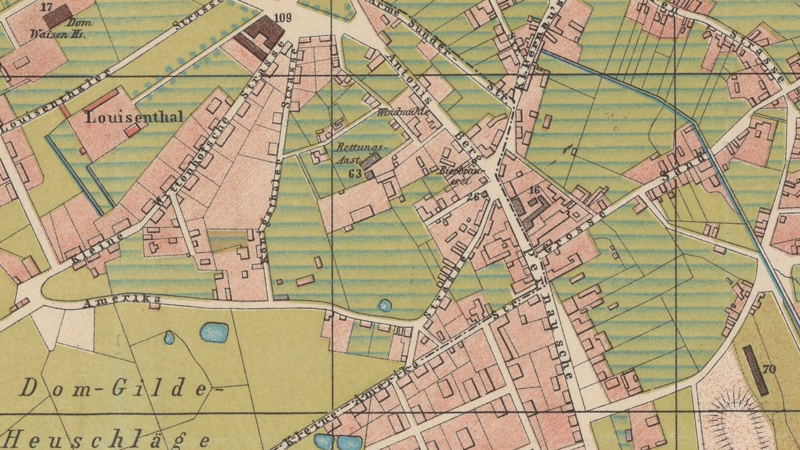
Detail from map of 1880s Tallinn showing Suur-Ameerika tänav and Pärnu maantee along with the Bierbrauerei (brewery) which may be the Wirthaus America (America Inn) of records.
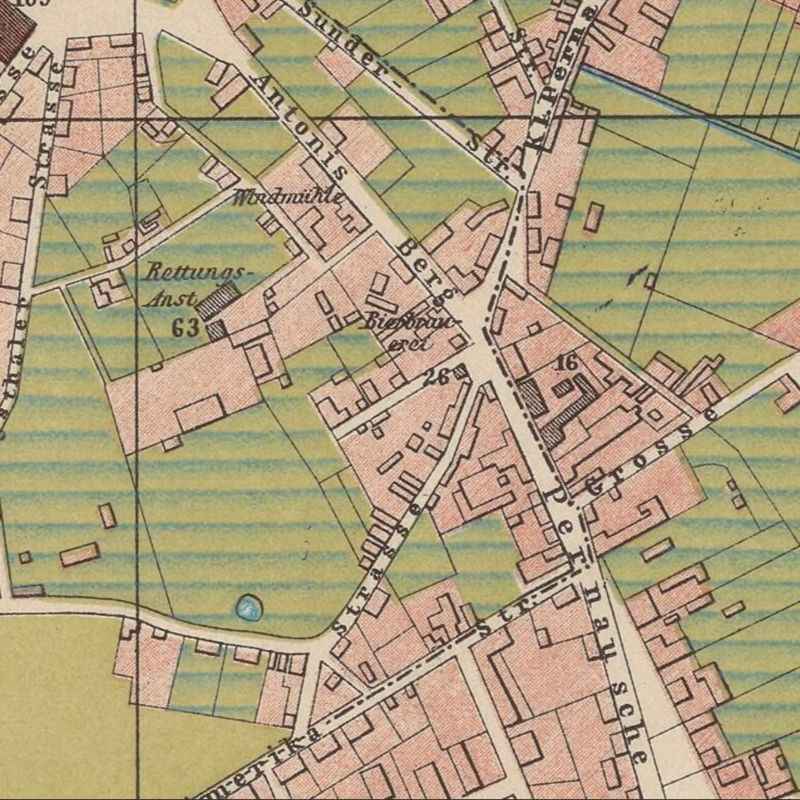
Close-up detail from map of 1880s Tallinn highlighting the Suur-Ameerika tänav, Antonis berg and Pärnu maantee crossroads with the Bierbrauerei (brewery) in the middle.
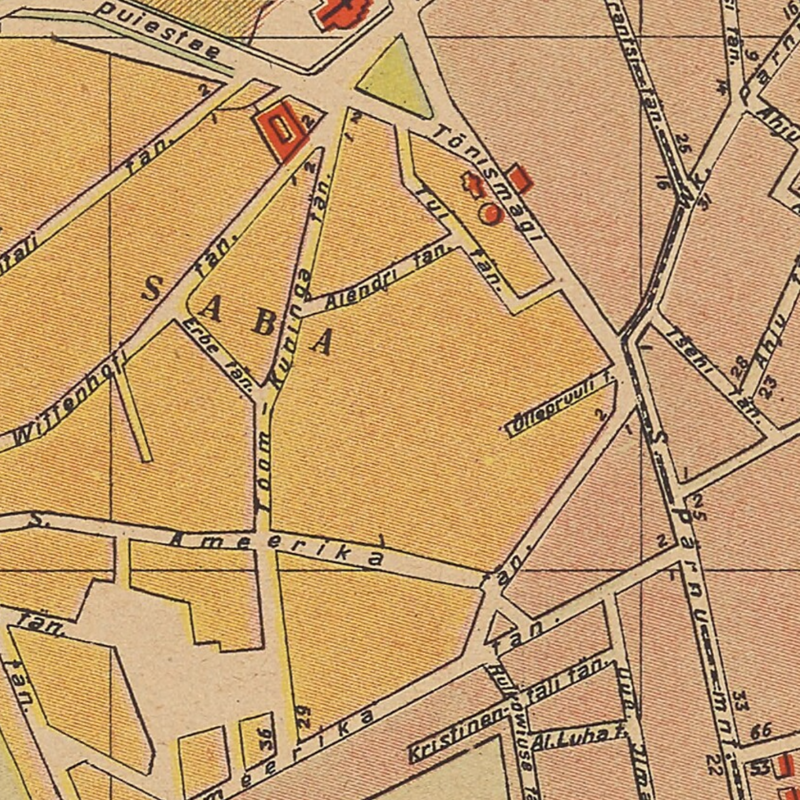
Close-up details of the 1922 Tallinn map Topograafia Jaoskkonna Tallinna Linna Plaan naming Õllepruuli street at the Suur-Ameerika, Tõnismägi and Pärnu maantee crossroads.
Suur-Karja (Suur-Kari)
Greater/Upper Cattle (also flock, pack, troop, crowd), once leading to pasture outside town. Earliest recorded names in a mix of various languages including vee strate, MLG for cattle or livestock street (1362), Kariestrate, Esto-MLG for cattle street (1365), Lat. Platea or Strata Pecorum, Cattle gate (see Karja värav), with an attempted later gentrification, not without a touch of condescension (starting in Latin, finishing in the vernacular) of strata pecorum vulgaritur vestrate, i.e. more or less ‘Beef Street, commonly known as Cow Street’ (1363-7) sociologically similar to the English post-Norman-Conquest use of ‘beef’, from the higher-status French term bœuf, instead of the everyday English cow/cattle. Known for a while as Michaelis-Straße / Михайловская ул. (1776), apparently after Russian victories of 1710 in the Great Northern War and a procession through the gate on Michaelmas day. Maybe. See also Väike-Karja.
Suur-Kloostri (Suur-Klooster)
Greater/Upper Abbey (convent, monastery, cloister...). After the Cistercian St. Michael’s Convent, Mihkli Klooster (1249-1629). Renamed (1950-1987) as Nooruse during the Soviet occupation.