
Home
Toom-Kooli (Toom-Kool)
Cathedral School, school founded in 1319.
Toom-Rüütli (Toom-Rüütel)
Cathedral knight. Renamed (1954-1987), but of course, during the Soviet occupation, as Linnuse.
Toompea (Toompea) 
‘On the cathedral’. Toom, from Ger. Dom, from Old Fr. dôme, borrowed from Ital. duomo from Lat. domus, metonym for ‘God’s house’ and thence, due to association with the church’s structure, for the dome itself. A wooden fortress known in Russian as Вышгородъ (Vyshgorod, or upper city) is said to have existed there as far back as the 10th C, so the name has been used as much for the castle – castrum (fortress, 1319) and, four centuries later, Ordensschloß or das schloß (Order’s castle, or just plain castle), in Est. as linnapä (top of or above the fortress / citadel) – and the locality: Вышгородъ (Vyshgorod) again or der Dohm (Ger.) or toompä (Old Est.), even getting a mention in Võru as Tuuḿpää. One of Vanalinn’s 4 main Wards (see also All-Linn). Legend has it as Kalev’s final resting-place (see Kalevipoja); archaeologists are still digging… See Toompea tänav.
Vabaduse väljak (Vabadus)
Freedom, liberty. Built over part of the former city walls and bastions (southern part of Pommeri Bastion and northern part of the 1686 Berghi Ravelin), today’s ‘Freedom Square’ has gone through many, many changes. The sequence seems to have been (list lifted from KNAB), if order is possible, first language then most recent date order (with dashes: durations; dates alone: records), roughly as follows:
- 1938; 1939-1941; 1942; 1989-: Vabaduse väljak (freedom square, back at last in 1989. NB: väljak (square) is and sounds more Estonian than the German-sounding plats (also square)
- 1938: Vabadusväljak (ditto)
- 1923-1939: Vabaduse plats (ditto)
- 1966-1989: Võidu väljak (victory square, revamp, note space)
- 1941-1941 (yup, short); and 1948-1966: Võiduväljak (by the Soviets, twice)
- ±1921: Harju turg (market)
- 1875(?), 1910; 1921-1923?: Peetri plats (Peter’s square, after Peter I)
- 1908; 1910: Heina turg (hay market)
- ?: Puu- ja Heinaturg (wood and hay market)
- ?: Palgi turg (timber market)
- 1942: Freiheitsplatz (freedom square)
- 1913: Peterplatz (Peter’s square, after Peter I)
- 1910: Peters-Platz (ditto)
- 1907: Heumarkt (hay market)
- ?: Holz- und Heumarkt (wood and hay market)
- ?: Вабадузе, площадь (Vabaduze ploshchad': площадь = square, transliteration of ‘Vabaduse’)
- ?: Свободы, площадь (Svobody ploshchad': translation of ‘freedom’)
- ?: Выйду, площадь (Vyydu, ploshchad': transliteration of ‘Võidu’)
- ?: Победы, площадь (Pobedy ploshchad': translation of ‘victory’)
- 1910; 1916: Петровская пл. (Petrovskaya pl., Peter’s square, after Peter I)
- ±1767: Новая пл. (Novaya pl.: пл. = sq., new, see Harju)
- ?: Сенной рынокъ (Sennoy rynok [old spelling]: hay (rynok = market)
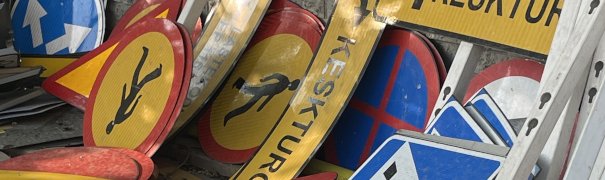
The manufacture of street-signs is clearly a good business in Estonia.